
Sulaiman Cisse | The Sunday Times – Business | 8 November 2026
The Witwatersrand Basin has produced nearly half of all gold ever mined. In the 1970s, South Africa accounted for almost two-thirds of global gold production. This wealth supported the Bank of England, maintained sterling as the world’s reserve currency, and funded imperial trade. However, little of the resulting industrial capability was developed in Africa.
This paradox defines Africa’s resource narrative: it drives global prosperity without delivering proportional benefits at home. The key question is whether the critical minerals boom will change this pattern.
The transition to clean energy, digital technology and AI has raised global demand for minerals such as lithium, cobalt, graphite, manganese, copper, titanium and rare earths, many of which are abundant in Africa. This demand is long-term, with governments and companies seeking secure supply chains and processed materials rather than raw ore. This shift gives Africa influence it has rarely held. However, most value is lost before significant industrial development occurs.
Estimates compiled from the US Geological Survey (USGS), World Bank and industry data indicate that less than 10% of Africa’s lithium, graphite, copper and gold is processed locally for batteries or other uses. For instance, Africa processes only 3%–5% of graphite, despite its importance in battery anodes. Cobalt is the exception, at about 20%, achieved only under intense geopolitical and governance pressure.
Africa’s broader industrial landscape remains challenging. The African Development Bank’s 2025 Africa Industrialisation Index reports that Africa accounts for less than 2% of global manufacturing and only 1.4% of manufactured exports. Manufacturing value added per person remains below 2014 levels. Even South Africa, once the continent’s leading industrial nation, has declined since 2010 and now trails Morocco.
Commodity dependence is not only a missed opportunity but also a source of instability. Copper accounts for 10%–15% of Zambia’s GDP and 70%–80% of its export earnings. When prices fell and the pandemic struck in 2020, Zambia’s economy contracted, and it was the first African country to default on its debt during the pandemic. Without local processing, downturns are more severe, and upturns fail to deliver lasting benefits.
Beneficiation addresses this challenge: processed products command higher prices, access more stable markets, create skilled jobs and support supplier ecosystems that endure beyond individual price cycles.
None of this is new thinking. The Africa Mining Vision, adopted by AU heads of state in 2009, observed that “most of Africa’s minerals are exported as ores, concentrates or metals, without significant value-addition” and called for “downstream linkages into mineral beneficiation and manufacturing”.
The AU’s Agenda 2063 envisages regional manufacturing hubs built around beneficiating Africa’s minerals so that the continent captures a greater share of the rents from its natural resources; its African commodities strategy is a flagship programme for that purpose. The AU’s green minerals strategy, published last year, commits to driving “value addition at source”.
Africa’s challenge is not a lack of strategy but of execution, with too few bankable projects translating policy into operational facilities.
South Africa has the world’s second-largest reserves of the titanium mineral, yet none is processed into pigment or metal in Africa. Instead, the continent imports all its pigment and metal requirements. Ilmenite, the primary raw material, is mined and exported from the continent for less than $300/tonne (about R5,000/tonne), while titanium dioxide pigment, used in paints, plastics, paper and inks, sells for over $3,000/tonne – more than 10 times higher.
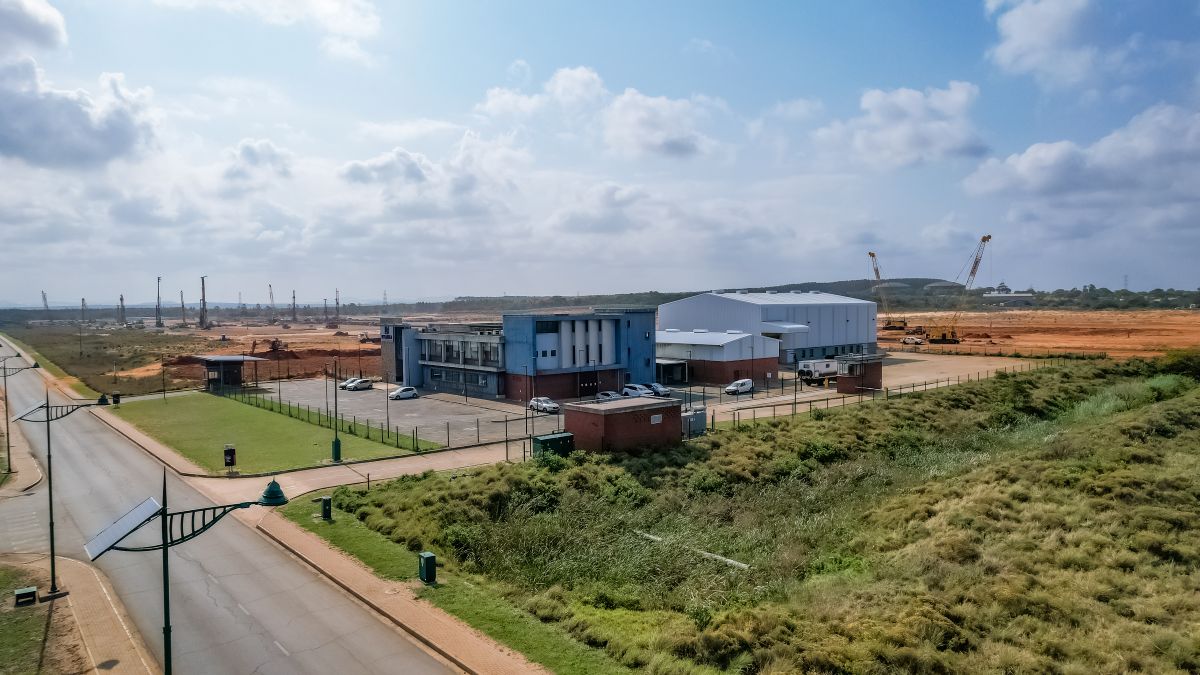
Nyanza Light Metals’ $850m plant in the Richards Bay Industrial Development Zone will address this gap by producing 80,000 tonnes of pigment annually as Africa’s first large-scale titanium dioxide facility.
In July 2021, the African Finance Corporation (AFC) became a co-development partner with Afreximbank and intends to participate in the principal investment of the project that will create about 3,000 construction jobs and 850 permanent positions, with 45% of the permanent roles targeted for women, along with import savings and increased export earnings.
The project’s financial viability was achieved through a phased approach. The support of South Africa’s Department of Trade, Industry and Competition (DTIC), and sponsor investment, enabled feasibility studies and a testing centre to produce customer qualification samples. East China Engineering Science and Technology Corporation (ECEC) was selected as the engineering, procurement and construction contractor.
The sponsors launched the Nyanza pigment brand using product from an existing ECEC plant, securing customers before construction began and incorporating protections in sales agreements to reassure lenders.
In October 2025, the African Development Bank approved its $75m in senior debt participation. The project began construction in June, with early civil works such as piling under way, and production expected within 36 months thereafter.
The project demonstrates the catalytic role that targeted industrial policy can play in building strategic beneficiation capacity. Early-stage project development support from the government, through the DTIC, helped de-risk critical development activities and laid the foundation for subsequent participation by institutions such as AFC, Afreximbank and the Industrial Development Corporation (IDC).
Nyanza’s impact extends beyond a single plant. Its by-products, skilled workforce and customer ties support a second phase: a battery-grade lithium iron phosphate project for storage, electric mobility and AI infrastructure.
This approach is applicable in other countries and minerals. It relies on four factors any resource-rich nation can provide: early public investment to reduce risks, special economic zones with strong infrastructure and incentives, early involvement of development finance entities, and big enough markets to absorb output.
Intra-African trade accounts for only 14.4% of the continent’s total, compared to 60% in Asia, according to the AfDB. Full implementation of the African Continental Free Trade Area (AfCFTA) would provide processors with the scale that national markets alone cannot achieve.
Africa needs projects like Nyanza. The Witwatersrand enriched other parts of the world; this time, the benefits should remain where the minerals are sourced.
Cisse is vice-president, project development and technical solutions at AFC.