
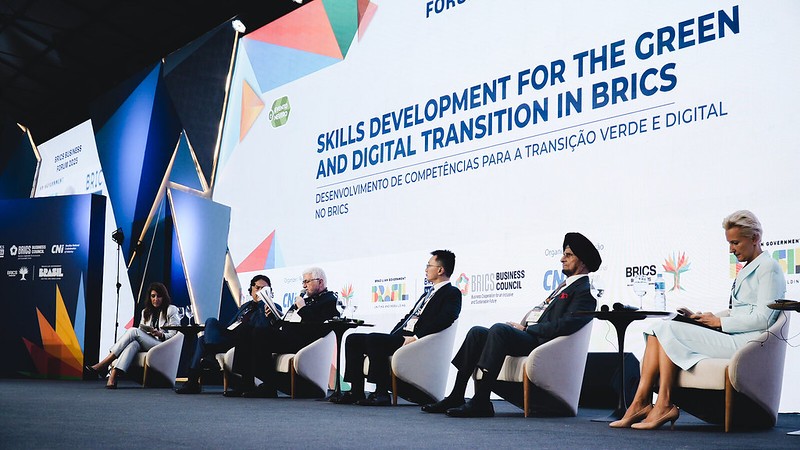
The BRICS Business Forum brought together this Saturday (5th of July), in Rio de Janeiro, businesspeople from major industries in the member countries to discuss topics relevant to the development agenda of the nations that make up the bloc. Check out what the CEOs had to say in the panels held throughout the day.
Energy transition and decarbonization
"It's inspiring to see the CNI's work and the BRICS countries' commitment to the green transition. COP30 will be a showcase for solutions from the BRICS. We will continue this dialogue until Belém, where we can demonstrate to the world our capacity for transformation," said Ambassador André Corrêa do Lago, president of COP30.
"No one feels the impacts of climate change more than farmers—and they are essential to global food security. We're investing heavily in research to increase resilience in the fields and develop solutions like microorganisms that help store carbon in the soil. If we reward those who produce and also help decarbonize the planet, we'll be valuing those who can truly save the world," said Jai Shroff, Global CEO of UPL.
"We represent 45% of the global population and 30% of global GDP—we have abundant resources and are determined to develop sustainably. China alone has already reached the 1,200 gigawatt solar and wind power target set for 2030, six years ahead of schedule. We are reducing costs, increasing efficiency, and making green energy more affordable. Taking this transition seriously is a real priority," said Zhao Haiying, executive vice president of China Investment Corporation.
"Since COP27, Egypt has committed to moving as quickly as possible toward a green economy. We've already begun closing high-emission industries and are replacing them with more efficient factories that use solar, hydroelectric, and wind energy. With the support of our BRICS partners, we've been able to develop wind farms and are investing heavily in solar panels. I believe that if we join forces as a bloc, we can make a difference in global decarbonization," said Marianne Ghali, CEO of Qalaa Holdings and Grandview Investment Holdings.
"In South Africa, we have made a firm commitment to decarbonization. More than just signing international agreements, we have developed a practical and inclusive framework to guide this process, involving the government, the private sector, and civil society. Every new project in the country must undergo a thorough environmental assessment. This ensures that any development is climate-responsible and does not hinder economic growth," said Thabane Zulu, CEO of the Richards Bay Industrial Development Zone.
"We've been operating as a mining company in the Amazon for 40 years, within a national forest and in partnership with ICMBio. Today, 60% of our production comes from high-quality ore, essential for reducing emissions in the steel sector. We operate in a mosaic of 800,000 hectares, with over 22,000 springs and 3,000 preserved species. Carajás demonstrates that legal and responsible mining is possible, combining production and conservation. Talking about forests also means talking about people," said Patrícia Daros, director of Nature-Based Solutions at Vale.
"DP World works directly in logistics, which accounts for approximately 24% of global carbon emissions—11% of which comes from road transport alone. Therefore, shifting to modes such as rail and maritime, which emit up to 45% less, is essential. We promote multimodal transport, which reduces costs and emissions, and we support the adoption of electric vehicles and renewable fuels," explained Rizwan Soomar, CEO of DP World Subcontinent & MENA.
Trade and food security
"There is a strong consensus among BRICS countries on the importance of promoting trade through regulatory cooperation and the elimination of technical barriers. In my opinion, two strategies are fundamental: regulatory alignment based on international standards—with coordinated non-tariff measures and voluntary sustainability frameworks—and mutual recognition of certifications, especially in the sanitary and phytosanitary areas, to avoid duplicate testing and approvals," said Yu Xubo, chairman of China General Technology Group Holding Co. Ltd. (Genertec).
"Without food security, no other form of security is possible. The BRICS countries have large reserves and production capacity. Russia, for example, produces 1.2 billion tons of wheat and consumes only 220 million. Yet only a quarter of the food imported by the BRICS comes from within the group itself. If we better integrate our trade, we can meet 100% of this demand and still export," noted Sergey Katyrin, president of the CCI RF.
"Brazil is an agrifood superpower with international credibility. Food security requires trust between countries and regulators. To strengthen the BRICS, we need: transparent and scientific regulatory alignment; technical cooperation between governments and the private sector; and sustainability with traceability, avoiding deforestation and illegal labor," said Helena Romeiro de Araújo, head of Government Relations at BRF/Marfrig and executive director of the BRF Institute.
"It's crucial that we create a system of mutually accepted certifications. Currently, it can take up to five years for a chemical component to be approved in another country. If we recognize certifications among the BRICS, we can accelerate production and strengthen global food security," said Mikhail Sterkin, Deputy CEO of Sales and Marketing at PJSC PhosAgro.
"Unfortunately, we face complex border procedures, outdated infrastructure, and tariff and non-tariff barriers. All of this increases costs and limits opportunities, especially for small businesses, women, and youth. The BRICS Business Council has already recommended reducing these barriers and digitizing trade. But we also need to address the risks of digitalization," said Busi Mabuza, chair of the South African Industrial Development Council.
"What we need is to strengthen the systems of the BRICS countries. Create a standardized and interoperable system at the borders, develop digitally integrated corridors across land, air, and sea. When the Red Sea crisis occurred, we reacted quickly: we activated a route from Pakistan to Uzbekistan via Afghanistan. In just 10 days, we transported cargo by road and rail, reducing delivery times from 40 days to 10. This shows that alternatives exist—they just need to be activated quickly," said Sultan Ahmed bin Sulayem, CEO and President of DP World.
Skills for the green and digital transition
"We are living in a changing world that, from a climate perspective alone, will affect 40% of global jobs. We're talking about approximately 1.2 billion jobs. Reskilling and professional qualifications need to be at the center of our discussions from a technology perspective. And the poorest workers and those in the most precarious regions need public policies that can compensate for the qualification processes. At the same time, we need to incorporate broad training into education, from the earliest years, that enables these transitions," said Fausto Augusto Junior, president of the SESI National Council.
"Our strategy is to proactively adopt technology to better serve our customers. We have about 10,000 engineers in China, and about 1,000 of them are algorithm engineers. So we develop robust algorithms to accurately match orders and ensure everyone receives their deliveries faster," said Qiu Guangyu, CEO of Keeta.
"The industry is short of people and professionals. It's important to try to develop skill sets, but the most important thing is upskilling and reskilling. Skills are constantly changing, and if you don't embrace the changes, you're out of business," said Onkar Kanwar, president of Apollo Tyres.
"In Russia, women's participation in the country's education sector reaches 82%, and the percentage of women among doctors is 70%. In the BRICS countries, despite improvements in education and employment, women are underrepresented and face barriers. In the field of artificial intelligence, the percentage of women is only 22%," highlighted Anna Nesterova, founder of Palekh Watch.
"The green and digital transitions feed each other. These two transitions will accelerate sustainability in the company and impact all sectors of the economy. They have a positive impact on the growth and development of the country as a whole," explained Majid Ghassemi, CEO of Bank Pasargad, Iran.
Industry and health
"SESI leads the Business Movement for Health because keeping workers healthy is essential, even though it's not the focus of companies. Today, healthcare is already the second largest cost for large companies. And half of industrial workers depend on the Unified Health System (SUS). Our goal is to help the business sector better manage these costs and collaborate with the government to improve public services. We already have companies engaged, and one of the main focuses is integrating health data for more efficient decision-making," said SESI's managing director, Paulo Mol.
Financing for the BRICS development agenda
"The global trade finance gap reached over $2 trillion by 2024, and small and medium-sized businesses are the most affected—about 50% of credit applications are rejected, mainly due to lack of collateral. The traditional banking model doesn't serve SMEs well. Therefore, we believe the solution lies in a system that integrates logistics, banks, government, and companies, allowing for better risk pricing and expanded access to finance," said Raj Jit Singh Wallia, CEO & MD of DP World Central Asia.
"We face a great opportunity: to discuss social programs, the green economy, renewable energy, and inclusive development. I see three solutions. First, the instruments. We have multilateral funds that are already investing in green projects in Brazil. Second, we need to unlock capital through better governance, strategic partnerships between development banks, and investments in the workforce and digital inclusion. And third, the role of the NDB. With good projects, we can make progress—especially in supporting small and medium-sized businesses," noted Francisco Lassalvia, vice president of Banco do Brasil.
"We need environments that truly enable access to credit. What we see are systemic barriers—macroeconomic systems end up inhibiting financing, especially long-term financing supported by development banks. The way risk is assessed today doesn't allow for adequate allocation, making contracts expensive and often ineffective," warned John W.H. Denton, secretary general of the International Chamber of Commerce.
"We need to support sectors that face greater challenges in reducing carbon—this generates jobs, social acceptance, and sustainable growth. The green transition doesn't mean higher costs; it identifies more efficient and profitable companies. The government must send clear signals to the market and offer incentives, such as the Central Bank of China, which finances the transportation sector with low interest rates. And technology, such as artificial intelligence, plays a crucial role in assessing risks and driving a safer and more efficient transition," said Yang He, president of the ICBC Research Institute for Modern Finance.
"We're in BRICS, but we're still trying to fit into an outdated financial system. We need to unlearn, redesign, and establish a new architecture that reflects the bloc's agenda," said Lebogang Zulu, chair of the board of Africa Women's Bank.
"We need to think outside the box and create inclusive financial systems from the ground up—sensitive to the diverse realities and transformative potential of women entrepreneurs. In Brazil, FAMPE (Micro and Small Business Guarantee Fund), which we manage at Sebrae, has already leveraged over $6 billion in credit for small businesses, with a special focus on women in vulnerable situations. When credit is provided with technical support, they have impressive success rates," emphasized Margarete Coelho, director of Sebrae.
About the Forum
The BRICS Business Forum is a platform for advancing cooperation in the face of global challenges, bringing together the efforts of member countries to promote an agenda based on innovation, sustainability, and economic inclusion. The event is sponsored by XCMG , DP World , Keeta , WEG , Embraer , Vale , Febraban , Mebo International , Marfrig/BRF , the National Service for Industrial Training (SENAI) , the Social Service of Industry (SESI) , and the Euvaldo Lodi Institute (IEL) , in addition to the institutional support of the National Council of Sesi , the Organization of Brazilian Cooperatives ( OCB ), Natura , SEBRAE , ApexBrasil , and the Federation of Industries of Rio de Janeiro (Firjan) .